
By Ryan Brechlin, Bottle Size Guide
Common Wine Bottle Sizes and Dimensions
This wine bottle fill levels guide starts with the sizes you’ll see most often. Exceptionally old or artisanal wines sometimes turn up in unusual sizes. But production has become far more standardized over the years. As a result, the market now favors a handful of common decanter sizes:
- Half Quarter (aka “Topette”): 93.5 ml
- Quarter Bottle (aka “Piccolo”): 187 ml
- Half Bottle (aka “Demi” or “Split”): 375 ml
- Standard Bottle: 750 ml
- Magnum: 1.5 liters
- Double Magnum (or “Jeroboam” for Champagne, Burgundy and Rhone): 3 liters
- Jeroboam (for Bordeaux): 5 liters*
- *pre-1978 standard Jeroboam fill was 4.45 liters
- Rehoboam: 4.5 liters
- Imperial (for wines): 6 liters
- Methuselah (for Champagne): 6 liters
- Salmanazar: 9 liters
- Batlhazar: 12 liters
- Nebuchadnezzar: 15 liters
- Melchior: 18 liters
- Solomon: 20 liters
- Sovereign: 25 liters
- Primat (aka “Goliath”): 27 liters
- Melchizedek: 30 liters
- Maximus: 130 liters
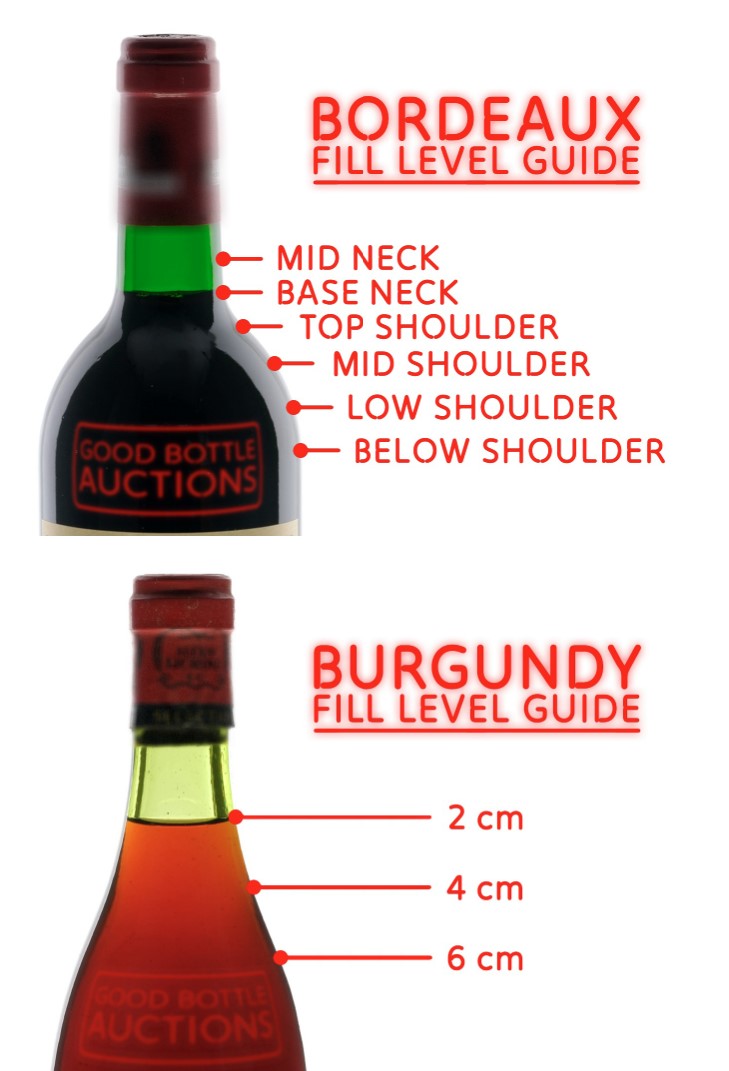
Wine Bottle Fill Levels Guide
Fill levels give a general condition statement for the wine inside each bottle. Lost volume should match the wine’s vintage, since evaporation happens naturally through semipermeable cork over time. Excessive losses, however, point to problems with the original bottling or mishandling over the years.
Bordeaux Bottle Fill Levels
Bordeaux bottles have a distinct “neck.” So we describe fill levels in relation to that line and the sloped “shoulder” beneath it. Here’s what the fill level can tell you about a Bordeaux bottle:
- Mid neck (abbreviated MN): a bottle generously filled above the neck line and expertly stored. If the vintage exceeds 40 years, however, this may raise flags about re-corking.
- Base neck (abbreviated BN): a bottle filled to a current, generally accepted industry standard. Excellently stored.
- Top shoulder (abbreviated TS): a bottle whose fill is just below the line of the neck. Wines over 10 years old often show this level.
- Mid shoulder (abbreviated MS): a bottle whose fill sits at the approximate center of the shoulder’s curve. Wines 40 years or older often show this level. But it can also signal early cork failure or poor storage. Possibly inconsumable.
- Low shoulder (abbreviated LS): a bottle whose fill is below the center of the shoulder. Likely poorly stored. Probably inconsumable.
- Below shoulder (abbreviated BS): a bottle whose fill is approaching the bottle’s cylinder portion proper. It sits well below the slope of the shoulder. Consider it inconsumable.
Burgundy Bottle Fill Levels
Burgundy bottles have no distinct “neck.” So we measure fill levels by their distance, in centimeters, from the cork or capsule. Here’s what that distance can tell you about a Burgundy bottle:
- <=2 cm, exceptional storage.
- <4 cm, typical for a wine 20 years or older (excellent for wines 35 years or older). In wines 15 years old or younger, this level may raise quality concerns.
- =>6 cm, warrants caution in wines of any age. Poor storage or manufacturing is readily apparent. Likely inconsumable.
Get an Expert Appraisal
Understanding wine bottle fill levels is a great first step, but nothing beats an expert opinion. If you are ready to sell wine at auction, or just want a professional take on your collection, contact Good Bottle Auctions today.
